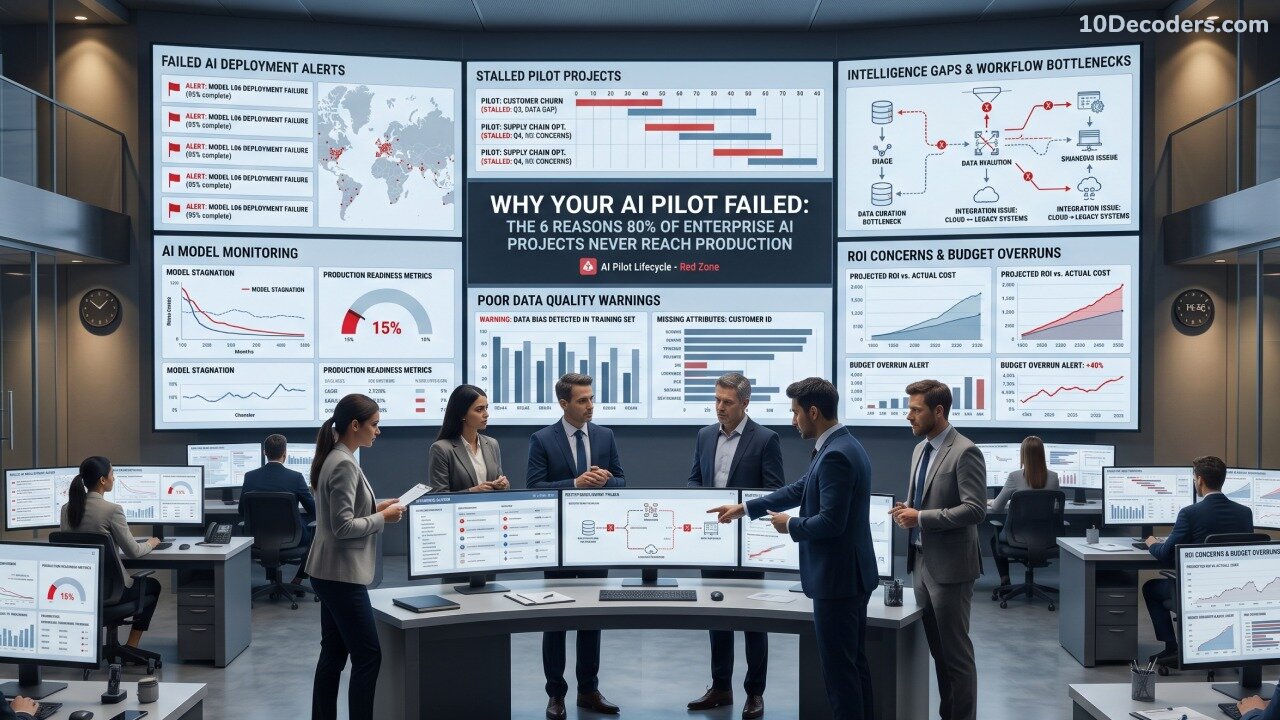
Why agentic AI stalls between the demo and the org chart
An agentic AI system is not a chatbot with a better prompt. It is software that plans, calls tools, and makes decisions on behalf of a business process, often reaching into production systems, customer records, and money. That autonomy is what makes the demo impressive and the deployment hard. A pilot only has to work once, in a controlled setting, in front of a friendly audience. A production agent has to work every time: on messy live data, under governance rules, with a clear owner for when something breaks.
That is why adoption numbers and production numbers tell two different stories. Surveys put roughly four in five enterprises somewhere on the experimentation curve, yet McKinsey's late-2025 research found only about 23% had scaled an agentic system anywhere in the business. Inside any single function, the ceiling sits closer to one in ten. The agents are everywhere as experiments and almost nowhere as infrastructure.
The gap is rarely about model capability. It comes down to seven unglamorous things a pilot gets to skip and a production deployment does not: governed data, identity and permissions, observability, evaluation, cost control, human oversight, and a named owner. Skip them in the pilot and the demo still works. Skip them at scale and the project turns into one of Gartner's annihilation statistics.
A pilot proves an agent can work once. Production proves it can be trusted a thousand times. Those are different engineering problems, and most teams only budget for the first.
Pilot reality vs. production requirement
The fastest way to predict whether a pilot will scale is to compare what it was allowed to assume against what production actually demands. The dimensions below are where those assumptions break. The risk column reflects how often each one is the reason a promising pilot never ships.
| Dimension | Pilot reality | Production requirement | Scale risk |
|---|---|---|---|
| Data foundation | Curated sample set, hand-cleaned for the demo | Live, governed, permissioned data with lineage and freshness guarantees | High |
| Identity & access | Runs under a developer's broad credentials | Scoped, auditable agent identity with least-privilege tool access | High |
| Evaluation | "It looked right" in a handful of test runs | Automated eval suite, regression tests, and accuracy thresholds per task | High |
| Observability | Logs read manually when something looks off | Traced steps, tool calls, and decisions with alerting and replay | Moderate |
| Cost control | Token spend ignored at demo volume | Per-task budgets, caching, model routing, and spend alarms at scale | Moderate |
| Ownership | The team that built the demo | A named business owner accountable for outcomes and escalation | Lower |
Notice that only one of these rows is about the model. The rest are data engineering, platform, and operating-model decisions. That is why the teams winning at agentic AI tend to be the ones who treated it as an infrastructure problem from day one, rather than a prompt-tuning exercise someone would "productionize later."
Not sure where your agentic AI deployment gaps are?
10decoders can walk through your current agent pilots and map exactly which of the seven gaps are standing between you and production. Takes less than an hour.
Book a Free AI Assessment →Why the data layer decides everything else
If you had to bet on one reason an agent fails in production, bet on the data. A pilot runs against a clean, frozen snapshot that someone prepared by hand. Production agents reach into live systems where records are duplicated, fields go stale, permissions are inconsistent, and the same customer shows up three times under slightly different names. An agent does not degrade gracefully against that. It confidently takes the wrong action, because it has no way to know the data underneath it is wrong.
This is the part of agentic AI that looks least like AI and matters most. Retrieval pipelines, entity resolution, access governance, freshness monitoring, lineage: none of it is glamorous, but it is the difference between an agent that summarizes the right account and one that emails the wrong customer. The organizations moving fastest in 2026 are not the ones with the cleverest agents. They are the ones whose data was already engineered to be trustworthy before any agent touched it.
The maturity journey is less of a leap and more of a sequence. Most enterprises move through three recognizable stages, and the failures cluster at the transitions rather than within the stages themselves.
Works once on a clean sample
Impresses stakeholders. No governance, eval, or cost model yet.
Real users, real data, narrow scope
Cracks appear in data quality, permissions, and oversight.
Governed, evaluated, observed
Governed identity, automated evals, observability, cost controls, and an accountable owner.
So many projects die between Stage 2 and Stage 3 because the work needed to cross that line is different in kind from the work that got the pilot built. It is platform engineering and operating-model design, not model selection, and it rarely fits inside the original pilot budget or timeline.
The seven agentic AI deployment gaps to close before you scale
The checklist below is the practical pre-production gate. If an agent cannot pass all seven, it is not ready to run a real business process at volume, no matter how strong the demo looked.
What to do this week
1.Inventory your live agent pilots and score each against the seven gaps
List every agentic experiment running across the business, including the ones a team spun up without telling anyone. Score each against the seven gaps as a simple pass or fail. The pattern that emerges tells you whether your blockers sit in data, governance, or ownership, which is the difference between a quick fix and a platform investment.
2.Pick one pilot with real business value and pressure-test its data foundation
Take the one pilot most likely to deliver measurable value and audit the data underneath it. Is the agent reading governed, permissioned, current data, or a curated snapshot? Run it against live records with deliberate edge cases like duplicates, stale fields, and restricted records, then watch what it does. The failures you find here are the ones you would otherwise discover in production, after they cost you.
3.Assign an owner and a kill criterion before you scale anything
For any agent you intend to push toward production, name the business owner accountable for its outcomes and decide, in advance, the condition under which you would shut it down. A documented kill criterion is not pessimism. It is the discipline that keeps a struggling project from turning into a cancelled one with months of sunk cost attached.
Agentic AI in 2026 will not be won by the team with the most ambitious agent. It will be won by the team that engineered a foundation the agent can be trusted to stand on. The seven gaps are where that foundation gets built, and your current pilots already hold the evidence of which one to close first.
Let 10decoders move your agentic AI from pilot to production
We help enterprises engineer the data, governance, and platform foundation that turns promising agent pilots into systems you can trust at scale — closing the seven gaps before they become cancellation reasons.